
Thediagnostic pediatric/young adult FISH panel includes testing for the following abnormalities using the FISH 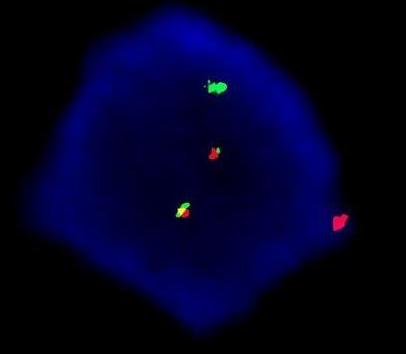 probes listed
- inv(16) or t(16;16), MYH11/CBFB
- t(8;21), RUNX1T1/RUNX1
- t(15;17), PML/RARA
- 11q23 rearrangement, MLL (KMT2A)
- t(6;9), DEK/NUP214
- inv(3) or t(3;3), RPN1/MECOM
- t(8;16), KAT6A/CREBBP
- t(1;22), RBM15/MKL1(MRTFA)
- -5/5q-, D5S630/EGR1
- -7/7q-, D7Z1/ D7S486
- 12p13 rearrangement, ETV6
- inv(16), GLIS2/CBFA2T3
- 11p15.4 rearrangement, NUP98
When an MLL (KMT2A) rearrangement is identified, reflex testing will be performed to identify the translocation partner. Probes include identification of t(4;11)(q21;q23) AFF1::MLL, t(6;11)(q27;q23) MLLT4(AFDN)::MLL, t(9;11)(p22;q23) MLLT3::MLL, t(10;11)(p12;q23) MLLT10::MLL, t(11;16)(q23;p13.3) MLL::CREBBP, t(11;19)(q23;p13.1), MLL::ELL, or t(11;19)(q23;p13.3) MLL::MLLT1. In the event an 11q23 translocation is identified by chromosome analysis, only the targeted MLL reflex probe will be performed if applicable
In the absence of RPN1::MECOM and RUNX1::RUNX1T1 fusion, when an extra MECOM signal and an extra RUNX1 signal are identified, reflex testing using the MECOM/RUNX1 probe set will be considered at the laboratory's discretion to identify a potential t(3;21)(q26.2;q22) rearrangement. Laboratory discretion may be influenced by available karyotype results
In the absence of RPN1::MECOM fusion, when an extra RPN1 signal is identified, reflex testing using the PRDM16/RPN1 probe set will be considered at the laboratory's discretion to identify a potential t(1;3)(p36;q21). Laboratory discretion may be influenced by available karyotype results.
In the absence of RPN1::MECOM fusion, when an extra MECOM signal is identified, reflex testing using the break-apart MECOM probe set will be recommended at the laboratory's discretion to identify a potential variant translocation involving MECOM, t(3;var)(q26.2;?). Laboratory discretion may be influenced by available karyotype results
In the absence of MYH11::CBFB fusion, when an extra CBFB signal is identified, reflex testing may be performed at the laboratory's discretion using the CBFB break-apart probe set to evaluate for the presence or absence of a potential variant translocation involving CBFB, t(16;var)(q22;?). Laboratory discretion may be influenced by available karyotype results
In the absence of PML::RARA fusion, when an extra or atypical RARA signal is identified, testing using the RARA break-apart probe set may be performed at the laboratory's discretion to identify a potential variant translocation involving RARA, t(17;var)(q21;?). Laboratory discretion may be influenced by available karyotype results.
When an ETV6 rearrangement is identified, reflex testing using the MNX1/ETV6 probe set will be considered at the laboratory's discretion to identify a potential t(7;12)(q36;p13). Laboratory discretion may be influenced by available karyotype results
When a NUP98 rearrangement is identified, reflex testing using the HOXA9/NUP98 probe set will be considered at the laboratory's discretion to identify a potential t(7;11)(p15;p15.4). Laboratory discretion may be influenced by available karyotype results
In the absence of RUNX1::RUNX1T1 fusion, when an extra RUNX1 signal is identified, reflex testing may be recommended at the laboratory's discretion using the RUNX1 break-apart probe set to evaluate for the presence or absence of a potential variant translocation involving RUNX1, t(21;var)(q22;?). Laboratory discretion may be influenced by available karyotype results
For more information see
ainheb.com
دیدگاه خود را بنویسید